
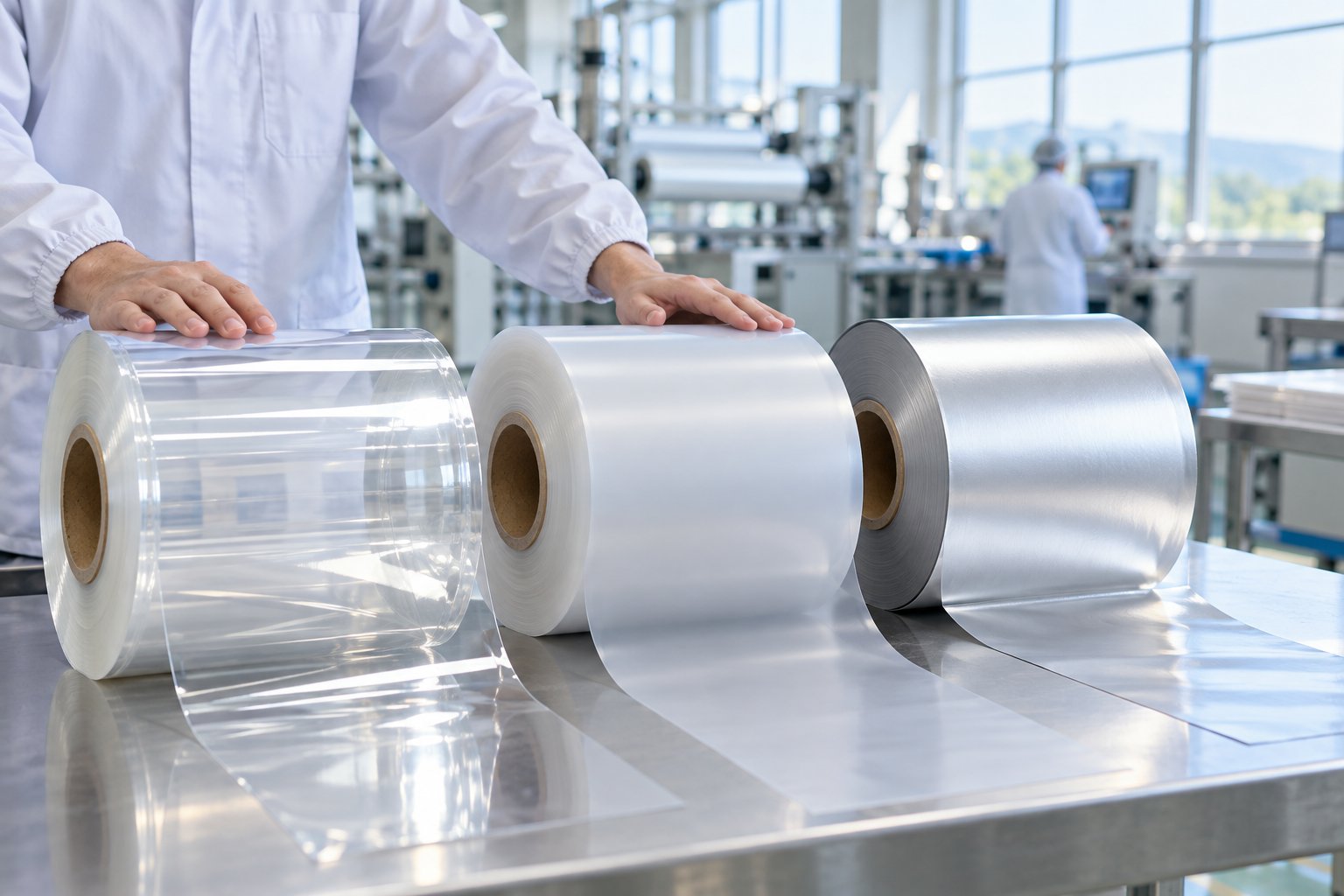
Most flexible-packaging conversations start with a brand or a bag shape, but the film structure underneath is what actually determines whether the pack survives shipping, seals reliably on your filling line, and looks right on shelf. BOPP, CPP and BOPA are three of the most common films behind everyday pouches, and each is good at a different job.
BOPP: clarity and cost efficiency
Biaxially oriented polypropylene (BOPP) is prized for its optical clarity, stiffness and relatively low cost. It is a common choice for the outer, printed layer of a laminate — the layer that carries your brand graphics — because it holds fine print detail well and resists scuffing during transport.
On its own, BOPP is not usually the sealing layer: its melting point is close to its orientation temperature, which makes it prone to shrinking or puckering under a heat-sealing bar. That is why BOPP is almost always laminated to a second film that handles the seal.
CPP: the sealing workhorse
Cast polypropylene (CPP) is unoriented, which gives it a wider, more forgiving heat-seal window and a softer hand-feel. It is the layer most commonly laminated behind BOPP or used as the inner ply of a pouch, because it seals cleanly even through light product contamination (oil, powder residue) at the seal area — a common real-world filling-line issue.
CPP also comes in retort grades for products that need post-fill sterilization, and in matte or soft-touch finishes when the brief calls for a premium feel rather than high gloss.
BOPA: toughness where it counts
Biaxially oriented polyamide (BOPA, or nylon film) is the film to reach for when the pack needs to survive rough handling, sharp product edges, or freezer storage. It has strong puncture and tear resistance and stays flexible at low temperatures, which is why it shows up in frozen food pouches, pet food bags with bone or kibble edges, and vacuum-sealed meat packaging.
BOPA is usually the middle or structural layer in a multi-ply laminate rather than the printed surface, since its cost is higher than BOPP for the same gauge.
A practical rule of thumb
Start from the failure mode you are trying to prevent, not the film you have heard of. If the risk is scuffed graphics and print cost, lean on BOPP for the outer layer. If the risk is a weak or contaminated seal, specify a CPP sealant layer with the right seal-initiation temperature for your line speed. If the risk is puncture, sharp edges or freeze-thaw cracking, add a BOPA layer to the structure.
Most production pouches combine two or three of these films rather than using one alone — the lamination is what turns three ordinary films into one pack that prints well, seals reliably and survives the trip to shelf.